Discounts
FAQs
Berkefeld Ceramic Sterasyl Filters
Yes we reduce Arsenic - Please see out testing data - Ultra Fluoride Test
Our bacterial claim is based on the filtration capabilities of the filter, and the small pore sizes that stop bacteria from getting through.
Recently a popular filter company got in trouble with the EPA because their filters have silver particles impregnated into the carbon filter to try to kill the bacteria.
Proper NSF/ANSI means that the system with the filter is tested to 200% of the manufacturers recommended life span. The 400 gallons for gravity is looked to be the optimum usage over a 6 month period at its peak performance for the element for the hundreds of contaminants that we have tested against. The simple reason that others say any more than that is that they have not tested their elements so can say whatever they like:)
Black filter brands have considerably larger pore sizes than British Berkefeld. If you're used to these brands and how quickly they filter, our Ultra Sterasyl and Ultra Fluoride may be a bit of a shock. They filter roughly 1 L per hour per filter. The pore size is smaller on British Berkefeld filters because it's doing a considerably better job of filtering. After discarding, the 2nd time of filtering will also be faster. We have the ability to put 4 filters in all systems above the Prince Berkefeld (1.58 gallon) which will cut the filter time in half.
Yes, these fit all gravity system on the market today. We will refund your order in full if it doesn't.
No, we do not recommend using Berkefeld water for CPAP machines because our systems do not remove minerals. CPAP machines will get damaged. Most CPAP machines require distilled water, as it does not contain minerals. As always, it is best to consult your doctor for any health related questions.
Learn about our NSF Certifications https://www.britishwaterfilter.com/nsf-certified/
Berkefeld owned by Doulton: The components and the filters performance are NSF Certified.
- NSF/ANSI 42
- NSF/ANSI 53
- NSF/ANSI/CAN 372
- NSF/ANSI/CAN 401
Baking soda: Researcher and author Dr. Robert O. Young has stressed the importance of pH balance for over two decades, and has considered ways to increase the alkaline levels in the diet by adding an alkaline ingredient to your filtered water.
Dr. Young recommends simply adding ½ a teaspoon of baking soda to a gallon of purified water and shaking it vigorously to ensure it mixes in completely. Because baking soda is highly alkaline, adding only a small amount to your filtered water will result in a gallon of alkaline water.
Fresh lemons: If you prefer not to use baking soda, a fresh lemon added to your drinking water will also, eventually, make your filtered drinking water more alkaline. Though it seems counter-intuitive to think that adding an acidic lemon to your purified drinking water could ultimately produce an alkaline result, it’s important to remember that fresh lemons are also anionic. Once you drink the acidic lemon water, it will become alkaline as your body reacts with the lemons’ anions during the digestive process. Use fresh lemons that haven’t been exposed to air for more than 30 minutes — not lemon juice purchased at the store or lemons that have been cut up and sitting out in the open at a restaurant all day.
Drops: One other option to increase the alkalinity of your filtered water is to add drops created specifically for that purpose. There are several over-the-counter drops on the market that can be purchased at health food stores or online. Follow the directions on the bottle to determine the correct amount to achieve your desired effect.
Hard water is basically the presence of calcium carbonate in your drinking water which then appears as limescale caking on the element in your kettle for instance. The ceramic filters do not soften or decalcify water. One of the main advantages of the Berkefeld filters is that the beneficial minerals present in the water are not removed such as is the case with reverse osmosis or distillation. You may find that the limescale build-up in your Berkefeld is less or disappears completely using Berkekeld filtered water. For instance you may see white particles floating in the bottom of your chamber instead of building up on the element. This is due to the fact that the ionic charge of the minerals changes by passing through the ceramic filters, the water becomes more alkaline and is then not able to hold all the minerals in solution, these minerals may then precipitate out and float in the bottom of the lower chamber. Every once in awhile you can rinse out the Berkefeld and your hard water issue is resolved. You may also find a gritty layer building up and adhering to the sides of the lower chamber. Cleaning out the lower chamber with a mild vinegar solution will get rid of this build-up.
Yes it works with well water. But you can't have a water softener installed. Berkefeld Filters are designed to remove heavy metals, but will not remove mineral salts, which are added by a water softener. The salt used to soften water will not be extracted by the Berkefeld Filters. You can use one of our system on a regular basis by bypassing your water softener to get your drinking water. Most water softeners have a bypass valve or way to get water before it passes through your softener. Therefore, we highly recommend that you obtain pre-softened water directly from the source rather than run softened water through the Berkefeld Filters.
The filters in Berkefeld Water Systems remove sedimentary minerals but keeps beneficial (ionic) minerals. This is because the media formation of the filter elements doesn’t attract beneficial minerals. So minerals such as calcium, sodium, potassium, manganese, and magnesium pass through the filter. Sedimentary minerals that are attracted to the filter media such as chloramine and chloride are removed from water along with heavy metals such as aluminum, cadmium, chromium and copper.
The shelf life of the Berkefeld ceramic filters is indefinite. In other words they will last until you need them.
Our set of Berkefeld ceramic filters are good for 800 gallons of water. Typically 6 months to a year.
California, Iowa and Wisconsin regulations prohibit the making of any health claims, such as the removal of pathogenic bacteria, on residential filtration systems using post carbon filters. Fairey Industrial Ceramics Limited (trading as Berkefeld Water Filters) is registered with the EPA under Establishment Number 69096-GBR-1. Even though Berkefeld products are registered with the EPA and NCF certified, these 3 states prohibit the making of any health claims, such as the removal of pathogenic bacteria, on residential filtration systems using post carbon filters. Sorry, we have to follow government rules.
Our Berkefeld Filters uses a combination of three different processes to filter water, including ion exchange and activated carbon filters, which are used to filter PFAS out of drinking water. Our filtration process starts off with our Ceramic Filters, which are made up of 6 different media types and have minuscule pores, making it difficult for contaminants to get through. On top of this, the filters use adsorption to keep more contaminants out. Ion exchange attracts heavy metals to the media, keeping even more contaminants out. Then, the gravity flow feature of our filter system has this process move slowly enough that contaminants have an even harder time to get through, but fast enough to help you get the filtered water you need. According to tests done by EPA-accredited labs, Berkefeld Ultra Sterasyl Filters remove over 99.9% of PFAS, including PFOA and PFOS, from the water along with other types of PFAS. That’s why each Berkefeld Water Filtration System gives you the reassurance that your water is free of contaminants. Our Ceramic Filters go above and beyond EPA and ANSI/NSF (Std. 53) standards and we are the only certifiable gravity flow water filtration system that is NSF certified for the performance.
Berkefeld Filters are designed to remove heavy metals, but will not remove mineral salts, which are added by a water softener. The salt used to soften water will not be extracted by the Ceramic Filters. You can use one of our filtration systems on a regular basis by bypassing your water softener to get your drinking water. Most water softeners have a bypass valve or way to get water before it passes through your softener. Therefore, we highly recommend that you obtain pre-softened water directly from the source rather than run softened water through your Berkefeld Filters.
DO NOT perform the red food dye test on white ceramic filters.
Eric Roy, PhD & Analies Dyjak, M.A.
The Red Dye Test is a visual demonstration used in marketing materials by various water filtration companies. In this demonstration, red food coloring is added to water and passed through a filter, where it comes out clear. Oftentimes this demonstration is done in a “side by side” manner against another water filter that does not remove the red coloring from the water. This demonstration suggests to the consumer that:
- If a water filter can remove red dye, it’s also removing dangerous contaminants. In scientific terms, they’re suggesting that red dye is a “proxy” or “surrogate” for dangerous contaminants.
- Water filters that do not remove the red color are not as effective as water filters that do remove red food coloring.
Fairey Industrial Ceramics Ltd, based in Newcastle-under-Lyme, is the sole manufacturer of Doulton® and British Berkefeld ceramic drinking water filters.
Ultra Sterasyl Filters are NSF Certified
In the United States, NSF International (formerly the National Sanitation Foundation) works to protect consumers by providing third-party testing, written standards, and validation of products available to the public.
Handmade since 1826 - Almost 200 years of continuous technical improvements to the water filter we launched in 1826
The Ultra Sterasyl reduce the following elements:
Turbidity:>98%
Bacteria (including E.coli, cholera, Shigella, typhoid, Klebsiella Terrigena):>99.99%
Cysts (including Cryptosporidium, Giardia): >99.99%
Range of pesticides:>95%
Medicines: >99.5%
Lindane: >99%
Atrazine: 99.38%
Benzene: >99%
Chlorine: >99%
Microplastics: 99%
Nanoplastics: 99% from a size of 0.5 microns (500 nanometers)
Heavy metals lead reduction pH 6.5: average 99.5%
Lead reduction pH 8.5: average 99.5%
Yes, plastic is BPA free, food-grade polypropylene.
The healthy mineral content in your water will increase, leading to a slight increase in your water's PH level.
British Berkefeld elements leave beneficial minerals in your purified water the TDS or Total Dissolved Solids, when tested with a TDS METER you might see a slight increase in TDS will be due to the presence of soluble, minerals in the ceramic. These minerals are Calcium and Magnesium which are both soluble and may partly dissolve in water as it passes through the filter causing a minor pH shift.
DO NOT expect a TDS meter to tell you whether your water is pure, this is misinformation.
A TDS meter does not register much of a change between the pre-filtered water and the post-filtered water. This is normal, and the answer has to do with what a TDS meter actually measures. According to tdsmeter.com, “Total Dissolved Solids (TDS) are the total amount of mobile charged ions, including minerals, salts or metals dissolved in a given volume of water, expressed in units of mg per unit volume of water (mg/L), also referred to as parts per million (ppm). TDS is directly related to the purity of water and the quality of water purification systems and affects everything that consumes, lives in, or uses water, whether organic or inorganic, whether for better or for worse.”
This statement is both correct and incorrect. It is correct in what a TDS measurement consists of, namely the “total amount of mobile charged ions, including minerals, salts or metals dissolved in a given volume of water”. It is incorrect in its conclusion that TDS is related to the purity of the water and the quality of the water purification system. If the measure of a water purification system was how close it could make water to pure H2O, then maybe it would be correct. But people need minerals to live. Thus, helpful minerals in your water are actually a good thing. A quality water filtration system should filter out things that are harmful to your body but leave in the helpful things such as minerals. The filter elements are designed to leave healthful and beneficial minerals in your water.
So, when our customers use a TDS meter, what they find is that the reading both before and after the water has gone through the filter elements about the same. And they are correct. The filter elements do not take out all of the beneficial minerals.
A TDS meter does not measure the amount of biological and chemical contaminants. The important thing is to not simply rely on a TDS meter for your measure of whether your water is good. You can have low TDS count water that has harmful bacteria in it. You can have high TDS count water that is perfectly safe (e.g. – pure, un-polluted ocean saltwater…albeit, you wouldn’t drink it, but that’s only because the mineral is salt). Thus, make sure you know what your TDS meter is actually telling you.
Great article...
TDS levels do not equal unsafe drinking water.
TDS meters are very popular among video reviewers looking to add what appears to be scientific proof to their claims. TDS (or total dissolved solids) is the sum of all dissolved ions in a water sample. These ions are typically things like sodium, calcium, magnesium, chloride, and bicarbonate, which are all common—and invisible—in drinking water. TDS meters are dipped into water samples to measure the presence of these substances.
TDS levels do not correspond to contaminant levels.
Typically, reviewers try to correlate low TDS levels with higher water quality, and high TDS levels with contaminated water. This couldn’t be further from the truth. The problem with using TDS as a stand-in for water contamination is that many of the ions measured in TDS are not harmful.
Neither high nor low TDS levels tell you about water quality.
Some waters may have high TDS concentrations but contain only harmless or beneficial ions—like calcium and magnesium, which are necessary to our diets and contribute to a pleasant taste. On the flip side, water samples may be low in TDS but contain hazardous contaminants.
Different samples with different TDS concentrations may all be equally safe to drink if none of the dissolved ions are contaminants hazardous to your health. (In fact, some luxury water brands have begun touting “high-TDS” water.)
It is worth noting that water with very low TDS typically tastes flat due to lack of minerals, so removing all TDS from your water will not improve its flavor either (though very high TDS—typically above 500 PPM—can make water taste salty).
Note: TDS meters are sometimes referred to as PPM meters or “water quality meters.” Both are incorrect. PPM is a unit of measurement that TDS is measured in, so if someone is calling it a “PPM meter” you know they don’t know what they’re talking about. And for all the reasons above, calling it a “water quality” meter is also completely off the mark.
Source: MyTapScore
Your water's mineral content will depend on where you live. British Berkefeld water filters will leave healthy minerals in your filtered water while filtering bacteria and pathogens. The best way to find out your individual water mineral content is to check with your local water provider. Your local water provider will be able to let you know.
Our ceramic filters remove iron in particulate form. >99.99% will be removed at 0.9 micron or >99.99% at 0.5 to 0.8 micron. Filtration is not suitable for dissolved iron.
Our ceramic filters remove aluminum in particulate form. >99.99% will be removed at 0.9 micron or >99.99% at 0.5 to 0.8 micron. Filtration is not suitable for dissolved aluminum.
Yes, the activated carbon in our candles reduces Oestrogen and synthetic Oestrogen in drinking water. Tested with Estrone.
The ceramic in our filters forms a physical barrier to bacteria, blocking its path while allowing clear, fresh water through. Our water filters are trusted worldwide to remove bacteria from drinking water by thousands of people.
Fluoride Filters
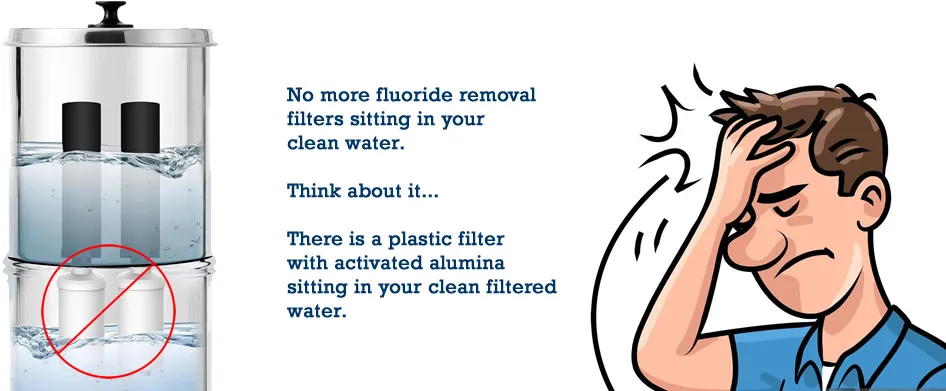
No. If you want to remove fluoride, you will no longer need PF2 Filters. You will want to purchase the Ultra Fluoride filters that sit in the top chamber.
You will no longer have plastic filters sitting in your clean water of the bottom chamber:)
The Ultra Fluoride gravity filter element has been tested to remove up to 99% of Fluoride up to 1,950 ppm - E.g. if your water contains 1ppm of Fluoride these filters will effectively remove it for 1,950 Litres before needing to be replaced. USA water companies can add a maximum of 0.7-1.7ppm (0.7-1.7 milligram per litre (mg/L)) of Fluoride to the water stipulated by the U.S. Food and Drug Administration (FDA)" Since August 2023 the U.S. Food and Drug Administration (FDA) has stipulated that the total amount of fluoride (added plus naturally occurring) cannot exceed 0.7 mg/L.
Our Stainless Steel gravity-fed systems can be used with our Ultra Fluoride ceramic candle that filters fluoride. Installed in upper chamber of Berkefeld System (Unlike other systems that need a filter up top and a fluoride removal filter in the bottom chamber)

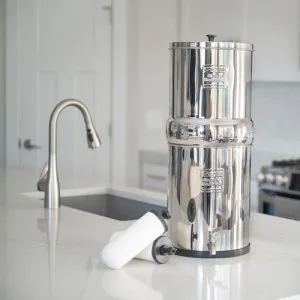
Berkefeld Ceramic Systems
Stainless steel is widely used because of its excellent strength, corrosion resistance, and fabric-ability properties. The type of stainless steel that Berkefeld manufacturing uses is austenitic 304-grade, which is also commonly used for appliances, commercial food processing, fasteners, and pipes. Berkefeld water filter systems are designed to weather the test of time, and the materials used are selected for their high quality. They aren't guaranteed to last forever, but with consistent care and proper maintenance, they'll be a part of your family's daily routine for a long time.
Berkefeld Water Filter's Scratch and Dent units are for sale at discounted prices due to minor blemishes or dents that most commonly occur in transit to us and did not pass for 'the new'/full sale price due to the blemish(s). All parts are new, unused, and guaranteed to work just as well as any other Berkefeld Water Filter System.
Cosmetically blemished Berkefeld systems come with the same warrantied Berkefeld Ceramic Ultra Sterasyl Water Filters (NSF Certified) you would receive in any of the full-price Berkefeld Water Filter systems.
Blemished Small Berkefeld system chambers ARE NOT warrantied against cosmetic defects. However, the Ultra Sterasyl Filters carry the standard 2-year pro-rated limited warranty, which provides you with the same performance and longevity as our full-priced Berkefeld systems.
When are they available?
We receive and inspect Berkefeld shipments weekly and they are listed as they become available.
Yes, these fit all gravity system on the market today. We will refund your order in full if it doesn't.
Yes! Rainwater can be collected, poured through the British Berkefeld water filter system, and then safely used for drinking or cooking.
Duchess Berkefeld Water Filter 1.7 Gallons 1 hour 30 min (2 filters)
Duke Berkefeld Water Filter 2.25 Gallons 2 hours 15 min (2 filters) 1 hour 8 min (4 filters)
Prince Berkefeld Water Filter 3.17 Gallons 3 hours 15 min (2 filters) 1 hour 38 min (4 filters)
Yes it is normal as this is a gravity filters and there will always be a little water left in upper chamber, and not unusual for the last 1.3 cm. to 2.5 cm. of water to remain in the upper chamber. By design the water must pass through very fine micro pores within the elements in order to pass from the upper chamber to the lower chamber. The lower the water level in the upper chamber, the lower the pressure available to force the water through the micro pores. You may have noticed that the system purifies much faster when full than when half full. That’s because there is more water pressure. The only way to remedy this problem would be to enlarge the pores of the filter elements. This would of course, reduce the efficiency of the Berkefeld Water Filter System. During each cycle the water left from the previous cycle mixes with the water from the current cycle and is then filtered. There is no need to be concerned about the excess water during normal use. Should you however discontinue using your filter for a period of time such as during a vacation, it would be best to empty both chambers before departing and leave them upside down to dry on the dish rack.
California, Iowa and Wisconsin regulations prohibit the making of any health claims, such as the removal of pathogenic bacteria, on residential filtration systems using post carbon filters. Fairey Industrial Ceramics Limited (trading as Berkefeld Water Filters) is registered with the EPA under Establishment Number 69096-GBR-1. Even though Berkefeld products are registered with the EPA and NCF certified, these 3 states prohibit the making of any health claims, such as the removal of pathogenic bacteria, on residential filtration systems using post carbon filters. Sorry, we have to follow government rules.
This will help determine what size to get.
Build a British Berkefeld System
Berkefeld vs Berkey Comparison
Alternative Gravity Systems
Take a look at our gravity filters comparison chart.
Berkey® International EPA Stop Sale or Removal Order
In 1998 Berkey® New Millennium Concepts® signed a distribution partnership with a British Berkefeld. The name “Berkey®” was inspired by, originated from the Berkefeld brand. Berkefeld helped establish Berkey®’s foundation and reputation. After a few years of success with British Berkefeld Water filters, Berkey® created their own Black Berkey® Purification Elements that you know of today. Some Berkey® dealers still sell British Berkefeld filters and New Millennium Concepts® original website is still up at britishberkefeld.com.
Fast forward to 2023: Berkey® International (part of Berkey’s supply chain) has been put under a Stop Sale or Removal Order (SSURO) by the Environmental Protection Agency (EPA).
Learn all about it: EPA Stop Order PDF
Yes, these fit all gravity system on the market today. We will refund your order in full if it doesn't.
Water Filter Care
A common cause of mold growth is when water has been allowed to sit in the system for too long. We recommend changing the water in the system regularly . If you plan to leave town for an extended period of time, empty the system and follow the proper storage procedures for the filters. Mold is never a good thing to find, especially in your Berkefeld water filter System. The good news is, mold can be easily removed and prevented. Mold growth is in the upper chamber of the Berkefeld System, where the unpurified and raw water enters the system, though in some cases it can pop up in the lower chamber as well.
Remove the Berkefeld Filters and scrub them with an abrasive pad or toothbrush. To clean the stainless steel housing, wash both the upper and lower chambers with warm water and a few drops of plain bleach that doesn't contain any artificial scents or additives. The bleach will effectively remove the mold and kill off any bacteria in the chambers. After these steps are completed, you can reassemble the system and begin purifying your water again.
Unlike Berkey filters, you do not need to prime the filters.
Are you over filling it? When lower chamber is partially filled, be cautious not to overfill upper chamber as this could cause lower chamber to overflow. For example, if the lower chamber is 1/3 full the upper chamber can be refilled by 2/3rds, if the lower chamber is ½ full, the upper chamber can be refilled by ½, etc.
What is an airlock? An air bubble prevents liquid from passing through. Most commonly found in pipes but can occasionally happen to a Berkefeld too. The upper and lower chamber fits very snuggly together, because of that it can create an air lock. To fix this we recommend using an anti-airlock clip, or adjust your upper chamber to allow for air flow. You can get one in this kit or just use a paperclip.
Empty the top chamber and leave the lid off to let the ceramic filters dry. That's it!
You should be able to recycle the plastic mounts* and compost the old filter element or use it to help with drainage in the bottom of your plant pots.
* Check with your local recycling center's - The mount is PPO and the adaptor ABS.
We suggest safely removing the mount using light pressure with a hammer to break it from the filter element. Next, cover the ceramic with an old rag and gently break it into small pieces, again using light pressure with a hammer.
If the filter is left unused for more than 24 hours, run at least half a gallon of water to waste before dispensing to drink, to ensure that your filtered water is fresh.
The filter housing is best cleaned by unscrewing the body from the head and wiping the surface and the inside of the body with a soft cloth dampened with warm water. Do this when you change your water filter.
No, there is no need to sterilize the ceramic candle. All our filters have bacteria inhibiting features built in.
Absolutely, this means that your ceramic filter is trapping dirt and bacteria that would otherwise be in your drinking water. If you find your filter blocking too often, look at using our Duo systems with a Sediment pre-filter that will help stop the blockages.
This is great news - your filter element is working! All that discoloration has been trapped on the filter's surface and is safely removed from your drinking water.
When your water flow (the speed water comes out of your tap) lessens, it might be time to clean your water filter.
First, empty and disassemble the Berkefeld Filters from the system. Use a cleaning pad similar to a Scotch Brite Pad or a stiff toothbrush and gently scrub the outside of the filters under cool running water. Reassemble the filters into the Berkefeld system.
Instructions & Manuals
Allow all the water to filter into the lower chamber. A small amount of water may remain, which is normal. Discard the first batch of water.
Our Company & Website
Yes, click here to learn more
Click here Lost your password?
California, Iowa and Wisconsin regulations prohibit the making of any health claims, such as the removal of pathogenic bacteria, on residential filtration systems using post carbon filters. Fairey Industrial Ceramics Limited (trading as Berkefeld Water Filters) is registered with the EPA under Establishment Number 69096-GBR-1. Even though Berkefeld products are registered with the EPA and NCF certified, these 3 states prohibit the making of any health claims, such as the removal of pathogenic bacteria, on residential filtration systems using post carbon filters. Sorry, we have to follow government rules.
It is already on a UPS truck. It should show progress when they scan the package.
Unfortunately, we can only ship to the 48 contiguous United States.
Wish we could, but the sales we have are as low as we can go. Thank you for your dedication and service!! Without people like you we would not have the freedoms we do!
The current promotion we are running can be found on this page after you sign up. https://www.britishwaterfilter.com/resources/
Please make sure your billing address matches your credit card billing address or the order will be denied. This is by design to prevent credit card fraud. You might want to call your credit card company and see if this transaction is being blocked.
No. British Water filter is an authorized dealer of Fairey Industrial Ceramics Ltd.
Fairey Industrial Ceramics Ltd, based in Newcastle-under-Lyme, is the sole manufacturer of Doulton® and British Berkefeld® ceramic drinking water filters.
You can call Doulton at +44 1782 664420 to confirm. Their website is www.doulton.com.
City Water Quality Test
California, Iowa, Wisconsin
Policies
Contaminant Reduction Chart
Water Filtration Learning
Video Library
System Overview
6 Videos

Contaminant Education
3 Videos

Setup & Maintenance
4 Videos
Filter Comparison Videos
1 Videos